Insights that power smarter energy decisions
Your source for practical insights on energy management, sustainability, CO₂ reduction and regulatory compliance.
The need for energy monitoring
As the world’s largest in-mould label manufacturer, with several production sites worldwide, MCC Global IML produces around 80 million labels every day. These labels can be found on packaging for products such as butter tubs and ice cream containers.
David, Facility Manager, and Benedict, Quality & Regulatory Manager at the Belgian division, joined forces with colleagues from production and maintenance. Together, they wanted to visualise their energy data in a clear and structured way to better understand where energy was being consumed and where opportunities existed to reduce consumption.
Visualisation, reporting and smart alarms
MCC Verstraete chose Enelyzer and has been visualising and monitoring its production data for more than 10 years using around 100 meters.
“We quickly realised that effective energy monitoring does not mean measuring every single machine individually. For example, we have 17 printing presses that are very similar. By monitoring four of them in detail, we obtain a representative picture of the entire group, while still being able to work in a targeted and cost-effective way.”
Energy meters and other measurement devices were connected, allowing MCC Verstraete to monitor both historical and real-time consumption in Enelyzer.
The next step was to move from “How much are we consuming?” to “What should our optimal consumption be?”
Following further analyses based on insights from the monitoring data, limits were configured for the machines in Enelyzer. This allowed MCC Verstraete to respond quickly whenever an alarm was triggered.
€15,000 saved thanks to a single alarm
“We can give several examples of machines that were incorrectly adjusted, leaks that went unnoticed, or wear and tear causing unnecessary standby consumption. Without Enelyzer, these issues would have remained under the radar and could have cost us a lot of money.
One striking example involved our polypropylene extraction system, one of our larger energy consumers and a crucial part of our label production process. We received an alarm indicating unusually high consumption. In the past, we would automatically have suspected the quality of the machine’s blades, but the alarm prompted us to investigate further.
It turned out that the machine’s rubber components were worn. By identifying the problem quickly, we avoided having to take the machine out of service for months of investigation and maintenance, resulting in a €15,000 saving.”
Enprove’s expertise
Dashboarding alone is not enough. MCC Verstraete realised this relatively quickly as well.
That is why the company called on an external energy expert from Enprove for additional support. Every two years, the cross-functional team comes together to identify new optimisation opportunities. In the meantime, the energy consultant continuously monitors the energy data and translates it into concrete improvement proposals every quarter.
“And this really is necessary,” Benedict explains. “The Energy Manager as a Service approach forces you to keep looking at your energy data, which is not always easy for a company to do consistently without external support.”
Annual savings of €135,000
MCC Verstraete has been working on energy-saving and sustainability initiatives since 2001, including ISO 14001, the replacement of lighting with LED technology, the implementation of Enelyzer, targeted actions following alarms, and a focus on Scope 1 and Scope 2 emissions.
In total, the company invested approximately €525,000.
The result of all these proactive measures? Today, that investment generates annual savings of €135,000, supported by targeted monitoring in Enelyzer.
Five practical tips for companies that want to make better use of their energy data
What lessons has MCC Verstraete learned along the way? David shares five practical tips for companies looking to get more value from their energy data.
1) Dashboarding alone is not enough.
Alarms are essential too. Keep your focus on the data and, above all, on the actions you can take based on it.
2) Work with an external energy consultant.
This ensures continuous monitoring of your energy data and helps translate insights into targeted optimisation measures.
3) Build a cross-functional team.
Bring together people from different departments to generate better ideas and identify optimisation opportunities more efficiently.
4) Measuring more machines does not automatically mean better monitoring.
Identify comparable machines and select representative ones for detailed monitoring rather than measuring everything.
5) Make your data visual.
Dashboards and templates in Enelyzer make results immediately understandable, including for your CFO, for example when demonstrating the savings that have been achieved.
How MCC Verstraete saves €135,000 a year with Enelyzer
Acting at the right moment—rather than simply reducing consumption—can now make a huge difference.
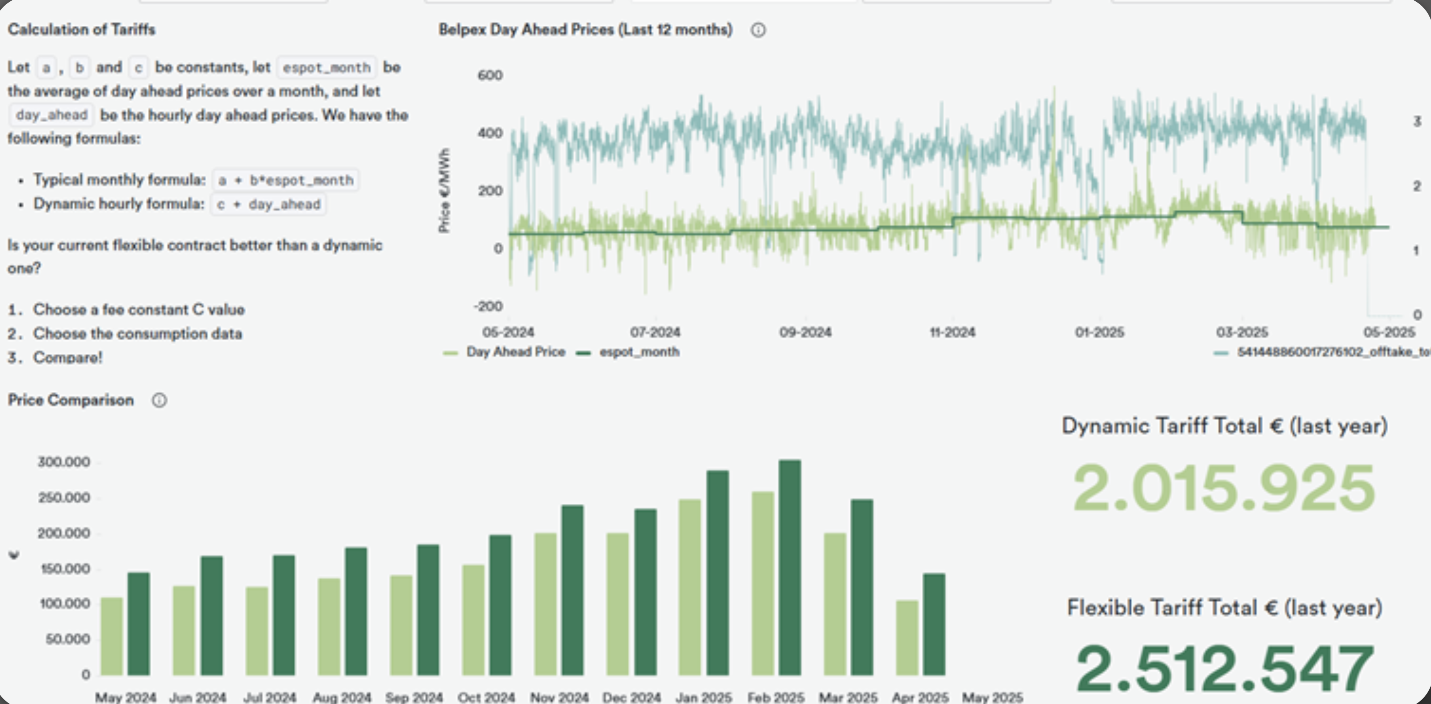
In a market with highly volatile and unpredictable energy prices, it pays to manage your consumption smartly: it’s cheaper, greener, and gives you greater control over costs. We are currently seeing that a well-negotiated contract is no longer enough to keep energy costs both controlled and minimal. Leveraging "behind-the-meter" flexibility always pays off.
Get a grip on your energy bill: if you cannot control your consumption profile, you become at the mercy of wildly fluctuating electricity prices—even with a fixed-volume contract.
On top of that, capacity tariffs have risen by 40%. Small adjustments can make a big (financial) difference; we help you identify where those opportunities lie.
Enter FlexScan: it provides clear, evidence-based answers to questions such as:
✔️ What opportunities does our consumption profile offer?
✔️ What impact will these have on pricing?
✔️ What is the financial risk if we do nothing? What results can you expect from the FlexScan?
✔️ It helps you cut through the complexity: identifying which avenues offer the greatest potential for savings and are worth investigating further.
✔️ This applies to both the short and long term: determining which future investments your company should consider to keep costs manageable and predictable five or ten years down the line.
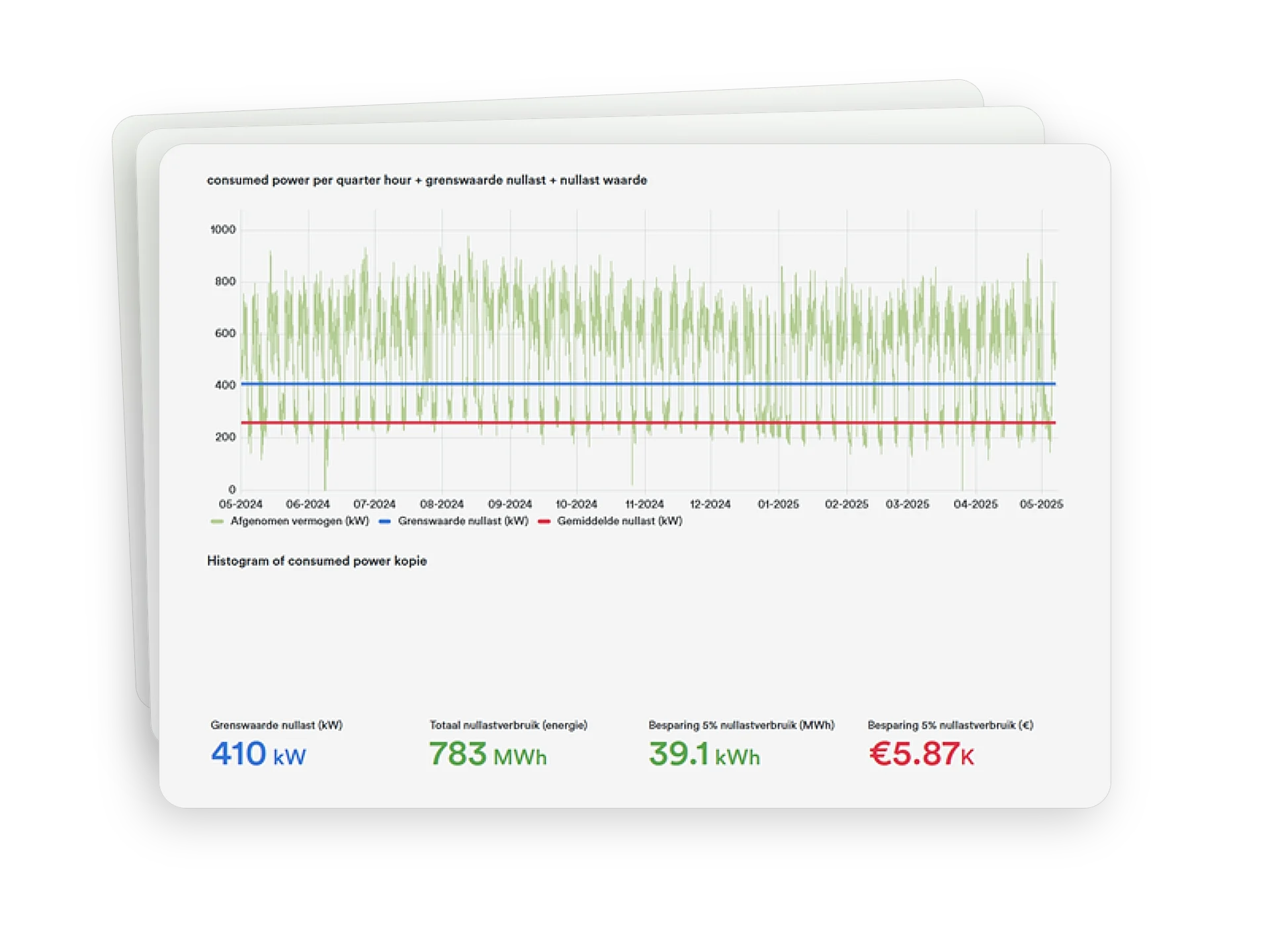
✔️ A clear dashboard providing a real-time analysis of your energy consumption. This marks the start of a process where the dashboard helps you take better control of your energy management.
How quickly will I receive my energy scan? We begin by connecting to the "Mijn Fluvius" platform. You then gain access to your personal dashboard, featuring a clear analysis of your energy consumption.
Finally, our experts share their insights with you.
Get a grip on your energy costs in uncertain times with our FlexScan
For companies with an annual energy consumption exceeding 2,778 MWh (10 TJ), new compliance obligations are on the horizon. For many businesses, this will be the first time they are subject to the mandatory energy audit requirement.
What does this mean for your business?
The most significant change is the lower threshold for mandatory energy audits. While the current legislation primarily applies to large energy consumers, companies with lower annual energy consumption will soon also be subject to additional compliance obligations.
The proposed framework is as follows:
- 10 to 50 TJ annual energy consumption: Mandatory energy audit and implementation of all energy-saving measures with a payback period of up to three years.
- 50 to 100 TJ annual energy consumption: Mandatory energy audit and implementation of measures with an Internal Rate of Return (IRR) of at least 13%.
- More than 100 TJ annual energy consumption: Mandatory energy plan, with the same profitability requirement (minimum IRR of 13%).
In addition, the entry threshold for the new Energy Policy Agreement (EBO3) will be lowered to 85 TJ (23,611 MWh), allowing more companies to participate.
Energy management becomes a structural requirement
Another important development is that companies with an annual final energy consumption of at least 85 TJ will not only be required to comply with audit and reporting obligations but will also need to implement an energy management system. The focus is shifting from periodic assessments to continuous monitoring and improvement of energy performance.
One way to meet this requirement is by implementing an ISO 50001 Energy Management System—the internationally recognised standard for establishing an effective and practical energy management system within your organisation.
The Flemish Government is also considering several alternative compliance routes, although these are still subject to the final legislation:
- ISO 14001 supplemented with energy management requirements; or
- An energy management system that complies with the future EBO3 requirements (an extension of the current Annex 9).
What does this mean for your organisation?
The practical implementation of the new legislation will be further clarified in the coming months. Now is the ideal time to assess whether your organisation will fall within the scope of these new obligations.
A timely review of your energy consumption and current energy management practices will help you avoid surprises once the legislation comes into force. Companies that start preparing now will also have more flexibility to spread the implementation over time.
Enprove helps you stay ahead
At Enprove, we support companies with energy audits, energy management, compliance with statutory energy obligations, and the implementation of practical energy-saving measures.
Would you like to understand how the new legislation will affect your organisation? Feel free to contact our specialists. Together, we will assess your situation and ensure you are well prepared for the upcoming changes.

EED Implementation into Flemish Legislation and the New EBO3 Framework
As the deadline is approaching rapidly, many companies are already looking to prepare thoroughly. Yet the same question keeps coming up: where do you start, and how do you approach this in a structured way?
During a recent seminar we organized, an auditor and a company shared their experiences and practical insights. Here are five key lessons learned that we would like to highlight.
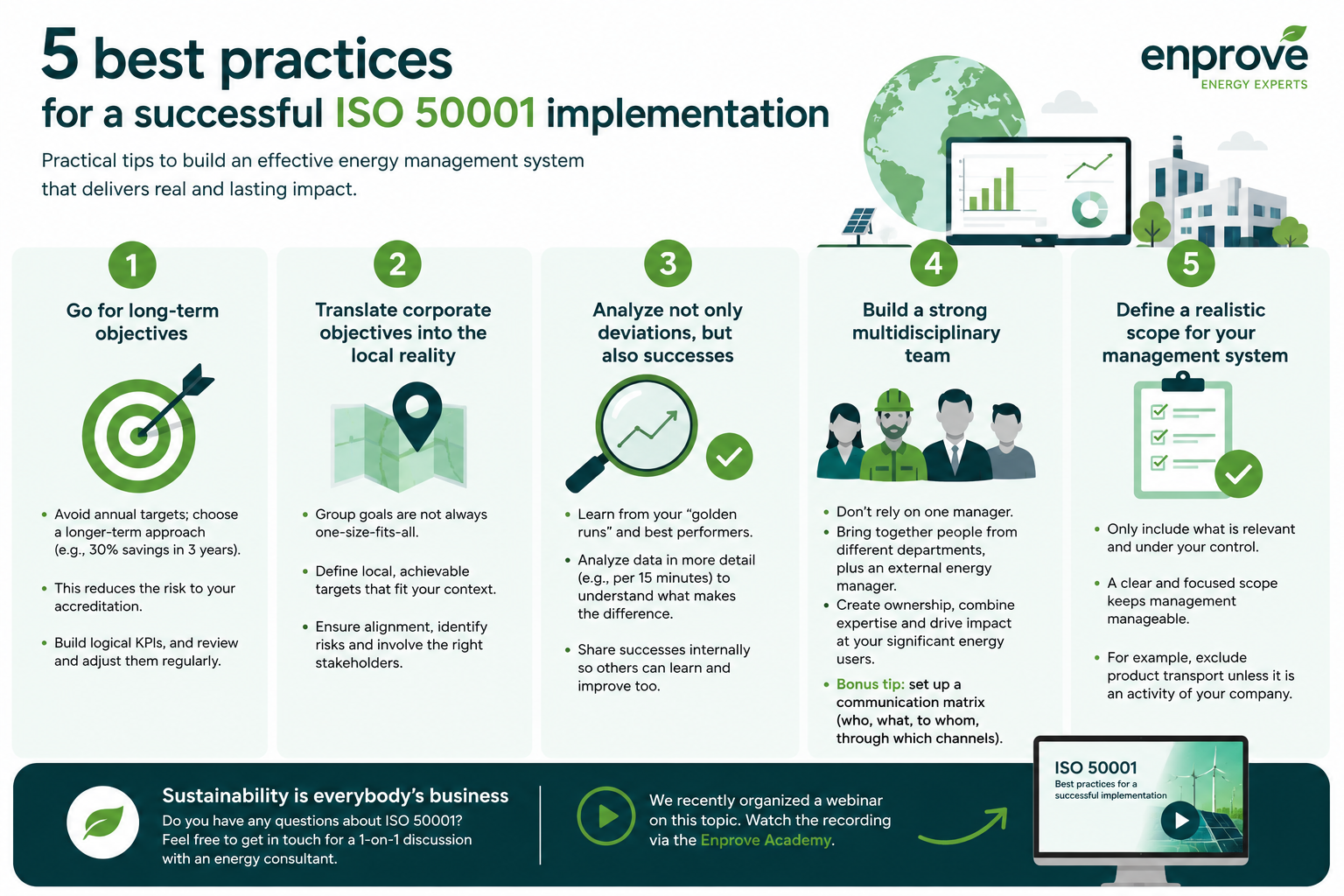
1. Focus on long-term objectives
We do not recommend working with annual targets. A long-term approach offers greater flexibility and is often more realistic. For example, aiming for a 30% reduction in energy consumption over three years is generally more achievable than committing to a 10% reduction every single year.
Failing to meet an annual target could put your accreditation at risk. By setting longer-term objectives, you reduce this risk while still maintaining a clear direction for improvement. Of course, targets can and should be adjusted along the way if circumstances change or new insights emerge.
In addition, make sure your KPIs are logical, relevant, and well-structured. Establish a clear method for reviewing them regularly and adjusting them when necessary—an important step that is often overlooked in practice.
2. Translate corporate objectives into the local reality
For companies with multiple sites, group-level objectives do not necessarily have to be adopted locally on a one-to-one basis. Each site has its own context, energy consumption profile, and improvement opportunities.
It is therefore perfectly acceptable to define site-specific, achievable objectives that reflect local realities. However, it is important to ensure proper internal alignment, identify potential risks, and involve the relevant stakeholders. In many cases, the corporate group sets the overall vision, while individual sites are responsible for translating that vision into concrete actions and targets.
3. Analyze not only deviations, but also successes
When monitoring performance, the focus is often placed on negative deviations. However, it is equally worthwhile to analyze your "golden runs"—periods in which outstanding results are achieved. These can provide valuable insights and best practices that can be applied elsewhere in the organization.
It can also be useful to examine data at a finer level of detail, such as 15-minute intervals. This often provides a clearer understanding of the factors that drive superior performance. In addition, make sure to share successes internally. Doing so allows other departments to learn from these achievements and contribute more effectively to the organization's energy objectives.
4. Build a strong multidisciplinary team
Do not make the implementation dependent on a single manager, but instead assemble a strong team of experts. Ideally, this team should consist of internal employees from different departments, complemented by an external energy manager.
This approach brings together expertise, creates internal support, and increases the chances of successful implementation. Moreover, a joint approach makes it easier to achieve more targeted impact among significant energy users.
Bonus tip: also establish a communication matrix. Define who communicates what, to whom, and through which channels.
5. Define a realistic scope for your management system
Carefully consider in advance which elements you want to include in your energy management system. The more specific and extensive your scope becomes, the more you will need to fully integrate it into your implementation and management processes. In practice, this level of detail is not always necessary.
Therefore, avoid unnecessary complexity and choose a clear and realistic focus. This keeps governance manageable and allows processes to be translated more efficiently into workable procedures and protocols. For example, it may be appropriate to exclude product transport from the scope, unless this is an activity directly managed by your own company.
Sustainability is everybody’s business
Do you have any questions about ISO 50001? Feel free to get in touch if you would like to have a one-on-one discussion with an energy consultant. We recently also organized a webinar on this topic. You can watch the recording via the Enprove Academy.
5 Lessons learned about ISO 50001
Executive summary
Many organizations implement ISO 50001 with the right intentions, yet fail to unlock its full potential. Instead of achieving measurable improvements, it often remains a compliance exercise.
The root cause rarely lies in the standard itself, but in the lack of structured, reliable, and actionable data.
This blog explains how Enelyzer helps organizations to:
- Turn fragmented energy data into actionable insights
- Make ISO 50001 operational
- Demonstrate energy savings
- Build a future-proof energy strategy
The gap between ISO 50001 theory and practice
ISO 50001 provides a strong framework based on continuous improvement (Plan-Do-Check-Act). In practice, however, organizations face several challenges:
- Limited visibility into energy consumption at process level
- Incomplete or inconsistent data
- KPIs that are not actively monitored
- Difficulty in demonstrating savings
- Time-consuming, manual reporting
As a result, energy management remains:
- Reactive rather than proactive
- Descriptive rather than predictive
Additionally, ISO 50001 is inherently a data-driven management system. Key elements depend heavily on data quality:
- Identification of Significant Energy Uses (SEUs)
- Definition of Energy Performance Indicators (EnPIs)
- Establishment of energy baselines
- Monitoring and analysis
- Demonstration of continuous improvement
Without robust and consistent data, achieving these becomes nearly impossible.
Enelyzer as the digital backbone for ISO 50001
Enelyzer acts as a centralized energy data platform that collects, structures, and analyzes data across sites and processes.
ISO 50001 audits require:
- Traceable data
- Consistent reporting
- Evidence-based decision-making
Enelyzer provides:
- A centralized data source
- History and transparency
- Standardized reporting
This results in audits become predictable and manageable.
Key ISO 50001 functionalities:
- Integration of multiple data sources (meters, production, contracts, external data)
- Data normalization (units, time zones, consistency)
- Validation and correction layers
- Structuring by asset (machines, buildings, processes)
- Scalability across multiple sites
This results in one reliable source of truth for all energy data.
Some examples:
Energy review and identification of SEUs
Challenge: Energy reviews are often based on assumptions or limited datasets.
With Enelyzer:
- Detailed consumption insights
- Identification of SEUs based on real data
- Correlation with operational parameters
This results in objective and data-driven prioritization.
Energy Performance Indicators (EnPIs)
Challenge: KPIs are often static and unreliable.
With Enelyzer:
- Automatic calculation of EnPIs (e.g., kWh per ton)
- Real-time monitoring
- Benchmarking across assets and sites
This results in KPIs become active steering tools.
Energy baselines and performance tracking
Challenge: Baselines are often not robust enough for audits.
With Enelyzer:
- Historical data with correction layers
- Modeling of expected consumption
- Before-and-after comparisons
This results in demonstrable and auditable improvements.
Operational control
Challenge: Without alerts, insights do not lead to timely action.
With Enelyzer:
- Real-time dashboards
- Automated alerts
- Asset-level integration
This results in energy management becomes part of daily operations.
Continuous improvement (PDCA cycle)
ISO 50001 is based on the Plan-Do-Check-Act cycle.
Phase >Traditional > With Enelyzer
Plan > Static analysis > Data-driven insights
Do> Manual actions > Structured follow-up
Check > Periodic evaluation > Continuous monitoring
Act > Delayed adjustments > Real-time optimization
This results in a continuous and automated improvement process.
From compliance to measurable impact
Organizations using Enelyzer within ISO 50001 achieve:
- 10% or more energy savings without major investments
- Faster detection of inefficiencies
- Reduced peak consumption and energy costs
- Reliable reporting
- Improved collaboration between teams
Key shift: Energy management becomes a strategic lever.
Future-proof energy management
Beyond ISO 50001, organizations are facing:
- Volatile energy prices
- Capacity tariffs
- CO₂ reporting requirements (e.g., CSRD)
- Integration of renewable energy and flexibility
Enelyzer supports:
- Integration of cost and contract data
- Optimization of energy usage
- Automated reporting
This results in a scalable platform that evolves with regulations and the market.
Conclusion
ISO 50001 defines what you need to do. Enelyzer determines how well you do it.
Organizations that combine both:
- Achieve measurable savings
- Strengthen compliance
- Build a data-driven strategy
In short:
ISO 50001 without data is administration.
ISO 50001 with Enelyzer is a competitive advantage.
About Enelyzer
Enelyzer is an advanced energy data platform for industrial organizations. It helps companies to:
- Monitor energy and CO₂ data
- Identify savings opportunities
- Support compliance
- Optimize costs and performance

How to use Enelyzer to achieve better results with ISO 50001
How Global Textile Alliance Saved €175,000 with Data-Driven Energy Management
In industry, "small" efficiency gains are rarely truly small. A few percent less standby consumption, smarter compressed air control, or better-tuned steam pressure… It quickly adds up in euros and CO₂ impact.
Global Textile Alliance is a strong example of this: thanks to a series of optimizations driven by data and insights from Enprove, the company achieved a total cost saving of approximately €175,000.
Gaining control over the major consumers
The production environment of Global Textile Alliance (GTA) is extremely energy-intensive: the company knits and weaves mattress fabrics and finishes and dyes yarns for mattress and upholstery fabrics.
Two major consumers, or "big guzzlers," stand out in their processes. The weaving mill is mainly powered by compressed air, resulting in high electricity consumption. Additionally, the dyeing department uses steam dryers to generate heat, which also creates a significant energy demand.
Stricter regulations and increased compliance pressure
On top of that comes the reality of the energy transition. The sector is under increasing pressure to reduce gas consumption and lower CO₂ emissions (within the framework of EBO obligations).
This translates into concrete questions such as: is it worthwhile to install electric boilers? How do you handle obligations regarding rooftop PV installations, including the necessary stability studies? These are decisions that require expertise across multiple fields.
Measuring, analyzing, and targeted adjustment
Global Textile Alliance decided to involve Enprove because certain aspects were too specialized to cover internally. We have now been working closely together for ten years, with Enprove experts supporting them in energy plans and monitoring reports, specific calculations, and developing suitable measures. Our experts are also always available for questions regarding energy consumption and its impact.
Collecting data to understand what’s happening
Previously, nothing was actually measured, and the compressed air system was outdated. Therefore, we conducted a temporary measurement to map the actual consumption. These meters were connected to our Enelyzer software, allowing us to measure and monitor energy data. Based on this, reports were created and the information could be "sized." In plain language: not just collecting numbers, but being able to specifically see where heat was lost, when standby consumption occurred, and where leaks were present.
Based on this, reports were prepared and the information could be "quantified." In simple terms: not just collecting numbers, but being able to clearly identify where heat was lost, when standby consumption occurred, and where leaks were present.
Where are the deviations and opportunities?
The data revealed, among other things, that the existing compressors’ switching was no longer aligned with consumption, causing the specific consumption to be higher than normal. Additionally, there was a relocation of the 10-bar compressed air network to a new site: based on actual consumption, it was now possible to make a well-founded estimate of how much heat recovery could be achieved.
Appropriate measures that truly deliver results
Based on all the insights, targeted actions followed. We critically reviewed supplier proposals for new compressors to ensure the solution matched actual consumption. We also advised investing in compressed air meters so that consumption could be monitored per department and leaks detected more quickly.
It was a significant investment, but one that Global Textile Alliance considers the right step: thanks to smart switching between pressure networks, the site became more flexible and compressor capacity could be better aligned with compressed air needs.
Small percentages add up to make a huge difference
Together with several additional optimizations, the result is clear: the processes are now significantly more energy-efficient. Global Textile Alliance reports a total cost saving of approximately €175,000. Here’s a summary of the "small" gains:
- 1.3% savings by reducing standby consumption
- 4% through steam optimization
- 4% through heat recovery
- 5% through compressed air optimization
- 3% through dryer optimization
All together, this naturally makes a huge difference in absolute numbers. This business case from Global Textile Alliance clearly shows how data-driven energy management can quickly pay for itself—even when significant investments are required.
Curious about where the (most profitable) levers are in your company? Feel free to get in touch; we’d be happy to explore it together—with a focus on payback time and IRR.